
All of Slovakia
How to choose solar window film
There is no single best window film. There is only the best film for your window. It depends on what bothers you, which way the window faces and what glass you have. It also matters whether we can reach the window from outside. This guide asks the same questions we ask on a site visit.
- Chosen by problem, not from a catalogue
- Samples right on your window
- Free site visit and advice
In short
Choose window film by the problem you want to fix. Against heat, use solar control film. Against glare, use a darker non-metallic film. For privacy, use mirror or frosted film; for security, safety film. Next, the window direction and glass type matter: double, triple or Low-E glazing. Finally, you choose interior or exterior film. For south- and west-facing windows in flats and houses, we most often recommend non-metallic 3M Prestige. On large insulating glass units we fit it as an exterior film.



What window film does for you
-
Less heat in the room
Depending on film and glass, it stops 36 to 85 % of solar energy. Homes and offices stay cooler in summer.
-
Less glare
You can see your screen and TV even in the sun. No need to keep the blinds down all day.
-
UV protection
The film stops up to 99 % of UV radiation. Floors, furniture and shop-window goods fade much more slowly.
-
No new windows needed
We apply film to your existing glass. A flat or house usually takes one day, with no dust or building work.

Step 1: What problem are you solving?
- Summer heat – solar control film. What matters is TSER (how much solar energy the film stops). The g-value matters too (how much heat gets through the glass). How dark the film looks does not decide it.
- Glare and reflections on screens – a darker non-metallic film. For example, 3M Prestige 40 or 3M Neutral. VLT tells you how much light the film lets through. The lower the VLT, the less glare.
- People looking in – by day, mirror (reflective) film helps. Day and night, frosted or sandblast-effect film helps.
- Broken glass and break-ins – safety film. It is tested to EN 12600 (impact on glass) or EN 356 (break-in resistance).
- Fading floors, furniture and goods – a quality solar film. According to the manufacturer, 3M Prestige blocks 99.9 % of UV radiation.
Solar energy has three parts. Roughly 3 % is UV, 44 % is visible light and 53 % is infrared, which is heat (IWFA). So a good heat control film does not have to be dark. It only needs to stop the infrared part. Such a film is called spectrally selective. It works like good sunglasses: you see through it, but the heat stays out.
Step 2: Which way the window faces
South-facing windows get the summer sun high in the sky. In winter the sun is low and shines deep into the room.
West-facing windows are usually the worst in summer. The afternoon sun shines low and straight in. That is just when the flat is already hot.
East-facing windows overheat bedrooms and kitchens in the morning. North-facing windows rarely need heat control film. There we deal with privacy, security or winter heat loss instead.
- South – a non-metallic solar film with medium to higher heat protection. For example, 3M Prestige 70 or 50.
- West – a stronger film, such as 3M Prestige 50 or 40. If glare is also a problem, choose 3M Neutral 35 Exterior.
- East – a lighter film, such as 3M Prestige 70. It suits you if the morning sun wakes you.
- North – heat control film is usually not needed. Consider winter, safety or frosted film.
- Roof windows and skylights – an exterior film that stops a lot of heat. See film for roof windows and skylights.
Step 3: What glass you have
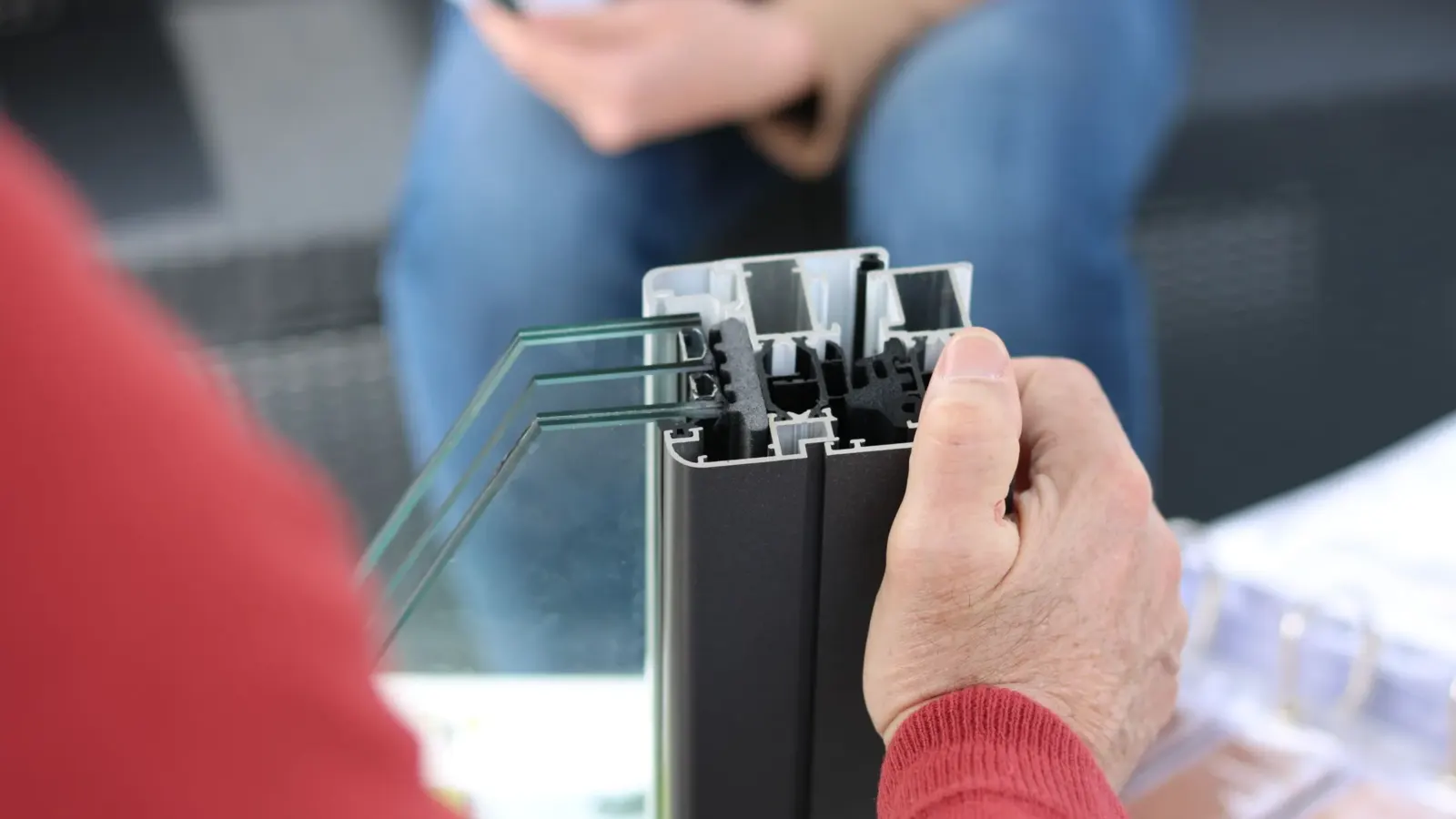
The glass type decides whether the film can go on the inside. Most interior films suit single clear glass and smaller double-glazed units.
Large panes, triple glazing, Low-E and tinted glass carry a risk of thermal stress. The glass then heats unevenly. It can crack from the edge.
That is why the 3M glass checklist requires a separate assessment. This applies, for example, to double glazing larger than 3.7 m². It also applies to interior film on triple glazing.
We explain this in our guide film on double, triple and Low-E glazing. On the site visit we check the marking on the spacer bar (the strip between the panes). We also measure the glass thickness and look at how the window is shaded.
Step 4: Film inside or outside
Exterior film stops heat before it reaches the glass. So it works better and puts less load on insulating glass.
Look at 3M’s data for standard double glazing. 3M Prestige 70 Exterior rejects 61 % of solar energy. The interior 3M Prestige 70 on the same glass rejects 42 %.
Interior film, on the other hand, lasts longer and is easier to clean. It also needs no outside access. See the comparison on interior vs. exterior film.
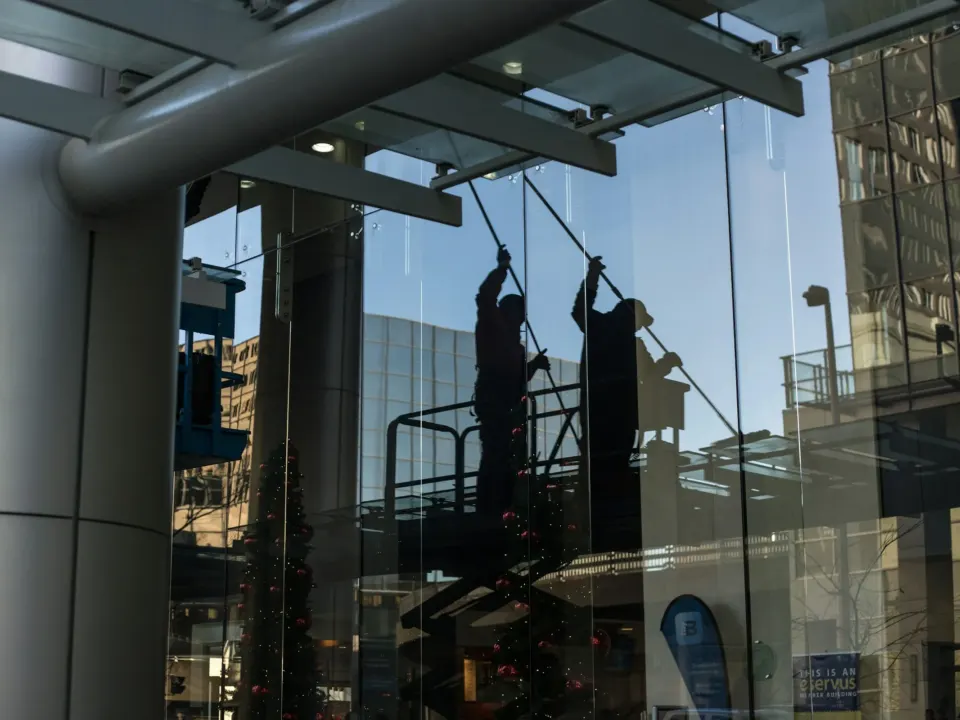
Sometimes the window cannot be reached from outside without a platform or scaffolding. We factor that in too. On glazed facades and at height we work from platforms. See high-access installation.
Step 5: Budget and priorities
Film is priced per m². The price depends on the film type, area, glass type and access. We explain this on the pricing page. Prices per m² and examples are in our guide how much window film costs.
Premium non-metallic films such as 3M Prestige cost more than metallic reflective films. But they barely reflect and do not interfere with mobile signal. They also change the look of the window less.
On a tight budget? Start with the windows that bother you most. These are usually west-facing and roof windows. More windows in one job, however, lower the price per m².
Consider other solutions too. We compare them on film vs. blinds, shutters and air conditioning.

How we advise and measure
- Photos and dimensions – send them to m2s@m2s.sk or via the form. Ideally, add the window direction and tell us what bothers you.
- Initial proposal – we suggest one or two suitable films. We add an indicative price.
- Free site visit – we check the glass type and the insulating glass marking. We measure the glass thickness and the visible glass area. We assess shading, blinds, heaters under the window and access.
- Samples on the window – we hold film samples against your glass. You see the colour, reflection and amount of light.
- Quote – you get a specific film and its performance on your glass. We state the manufacturer’s warranty for that film and the installation date.
- Installation and care – we apply the film wet. Then we briefly explain how to clean the film correctly.
Problem → right film → example
| Problem | Recommended film type | Example product | What to watch out for |
|---|---|---|---|
| Overheating, south- and west-facing windows | Non-metallic solar control film | 3M Prestige 70, 50 or 40 (interior and exterior) | Often exterior on insulating glass. |
| Heat without darkening | Spectrally selective film | 3M Prestige 70 Exterior, Avery Dennison SP e-Lite 70X | Does not reduce glare much. |
| Glare, reflections on screens | Darker film with low reflection | 3M Prestige 40, 3M Neutral 35 Exterior | Less glare, but also less daylight. |
| Strong heat and daytime privacy | Reflective (mirror) film | 3M Silver 35 Exterior, Avery Dennison R Silver | Mirrored outside; gone at night. |
| Privacy day and night | Frosted or sandblast-effect film | Avery Dennison DS Matte | Lets light through, not the view. |
| Broken glass, break-ins, children | Safety film | 3M S40 or S70 (EN 12600 2B2), 3M Ultra S800, Solar Screen Safe 4 C. | More protection: EN 356 P2A, e.g. 3M S140. |
| Security and heat at once | Combined safety and solar film | 3M Ultra Prestige S70 | One layer, two functions. |
| Roof windows, glass roofs | Exterior solar film for sloped glass | 3M Prestige Exterior, Avery Dennison SkyLite 20 XTRM PRO | Shorter warranty on sloped glass. |
| Polycarbonate, plastic skylights | Film made for plastics | Avery Dennison SkyLite 20 XTRM PRO Poly | Standard window film is not for plastic. |
| Fading floors and goods | Quality solar film with UV filter | 3M Prestige (UV 99.9 %) | UV is not the only cause of fading. |
Performance is based on manufacturers’ data. For 3M, EN 410 and NFRC apply; for Avery Dennison and Solar Screen, technical data sheets. We state the values for your glass type in the quote. We confirm the availability of each film in Slovakia for every job.
Preparing for the installation
Film is applied wet, so the fitter needs to reach the glass from the front and the sides with a squeegee, knife and sprayer.
Caring for window film
Do not clean the film for the first 30 days. A light haze and small water bubbles are normal. They disappear on their own as the film dries. In winter this takes longer.
Do
- Plenty of water with a drop of mild detergent (no ammonia)
- Soft microfibre cloth
- Rubber squeegee for the remaining water
- Clean exterior film just as gently as interior film
Don’t
- Razor blades, scrapers and rough sponges
- Cleaners with ammonia or grit
- Stickers, tape and suction cups on the film
- A pressure washer close to the edges of exterior film
Tip from practice: When you clean the frames, take care of the film edges. Do not lift them with a fingernail or cloth.
Full film care guideUpdated: November 2026
Why choose us to fit your film
We are a certified 3M Endorsed Installer. Our fitters were trained and tested by 3M itself. We have been fitting window and car films for 25 years. How long a film lasts depends on how well it is fitted.
We have even worked inside nuclear power plants
We fitted film at the Jaslovské Bohunice and Mochovce nuclear power plants. With security clearance, work permits and the strictest health and safety rules. We bring the same discipline to your flat or office.
Open shopping centres and work from platforms
Aupark, Eurovea and Polus did not close for us. We worked section by section and before opening. The work area was fenced off. We reached atriums and skylights from platforms. All our installers are certified for work at height and for operating aerial work platforms and walkways.
Only premium materials, data shown openly
We use only premium films from 3M, Avery Dennison, ORAFOL and Solar Screen. They last longer, keep their colour and carry a manufacturer warranty. For every film you get the data sheet and certificates. The values in our quote are the manufacturer’s figures to recognised standards. Not sales promises.
We tell you when film isn’t the answer
Sometimes film will not solve the problem. Or the glass could crack from uneven heat (thermal stress). Then we tell you plainly and suggest what to do instead.
How it works
From your first message to the finished job usually takes a few days. For buildings, we plan the work so it does not disrupt your operations.
Enquiry or photo
Fill in the online form and see an estimated price at the end. Or send a photo to m2s@m2s.sk. Rough sizes are enough.
Free site visit
For buildings, we visit, measure the windows and check the glass. Then we recommend a suitable film.
Your quote
We prepare it as soon as possible. It has a clear price, the exact material, a date and the warranty terms.
Installation and warranty
Our team of two installers fits the film. You get the data sheet, the manufacturer’s warranty terms and an invoice. For cars, also a certificate of installation.
Frequently asked questions
Didn’t find your answer? E-mail us or send a free quote request – advice costs nothing.
Send us an e-mailWhat is the best window film against heat?
There is no single best film for everyone. For flats and houses we most often recommend non-metallic 3M Prestige. It rejects a lot of heat, barely reflects and does not interfere with mobile signal. Reflective films reject the most heat. For example, 3M Silver 15 Exterior rejects 81 % of solar energy on single glass, according to the manufacturer. But they look strongly mirrored outside.
Which film for south-facing windows?
For south-facing windows, a non-metallic solar film with medium heat protection is usually enough. For example, 3M Prestige 70 or 50. On large insulating glass units we choose the exterior version.
Which film for west-facing windows?
For west-facing windows we choose a stronger film, such as 3M Prestige 50 or 40. The low afternoon sun heats them up. If glare is also a problem, the darker 3M Neutral 35 Exterior works well.
Which film for a flat?
For a flat we recommend non-metallic solar film, or reflective film for daytime privacy. The usual issues in flats are heat and neighbours looking in. Exterior and mirror films can change the look of the facade, so check the building’s rules. More on window film for flats.
Will heat control film make the room dark?
Not necessarily. Spectrally selective films let in plenty of light and mainly stop heat. According to the manufacturer, 3M Prestige 70 Exterior on double glazing lets through 63 % of light. At the same time it rejects 61 % of solar energy.
Can film be applied to any glass?
Yes, to almost any glass, but not every film to every glass. With double, triple, Low-E and tinted glazing we assess thermal stress. Wired, patterned and damaged glass is assessed individually. More in the guide film on double and triple glazing.
Will film replace air conditioning?
Usually not entirely. But it reduces the heat the air conditioning has to remove. See the honest comparison on film vs. blinds and air conditioning.
Does film interfere with mobile signal or Wi-Fi?
Non-metallic 3M Prestige films do not. Metallic reflective films can weaken the signal. We take this into account when choosing.
Can I choose the film from a sample?
Yes. On the site visit we hold samples directly against your window. You see the colour, reflection and amount of light.
How much does window film cost?
The price is per m². It depends on the film type, area, glass type and access. Guide prices and examples are in how much window film costs. Send dimensions or photos to m2s@m2s.sk or via the form. We will prepare a free quote as soon as possible.
What do I need to prepare before the film is applied?
Clear access to the windows: leave roughly 1 metre of free space in front of and beside every window. Move wardrobes, beds, desks and plants away beforehand, clear the window sills, pull curtains aside and raise interior blinds. If something heavy cannot be moved, tell us in advance and we will plan around it.
Related services
-
Solar control films
Less heat and glare in summer. 99.9 % UV protection, no mirror look.
Learn more -

Spectrally selective films
How film lets light in and keeps heat out. Compared with metallic films.
Learn more -
Interior vs. exterior film
Performance, lifespan, care and window access compared.
Learn more

Send us a photo of your window or car. We’ll prepare a quote as soon as possible.
A few details and a phone photo are enough. We’ll e-mail you a quote as soon as possible.